
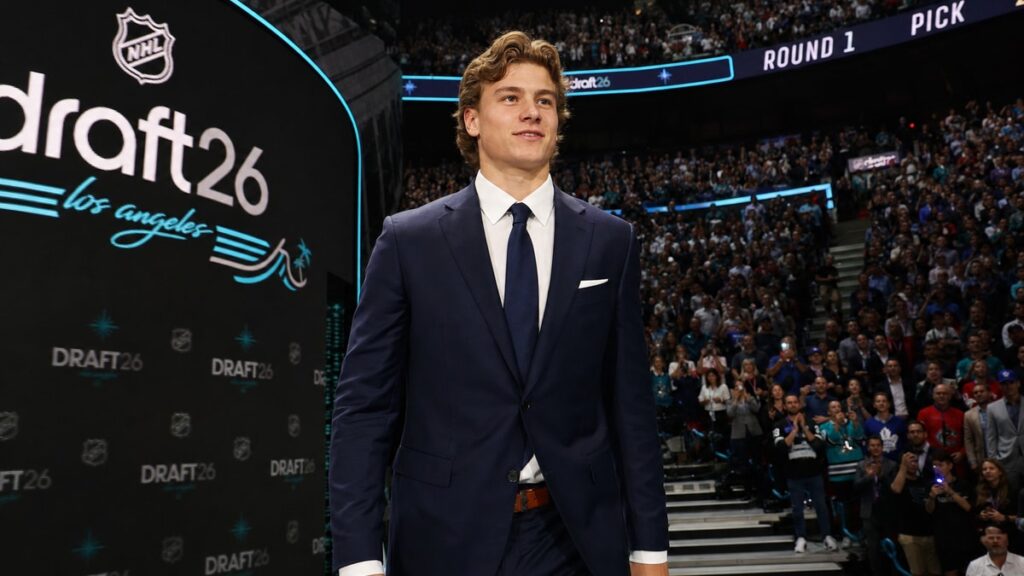
Every June, 32 NHL franchises gather to shape their futures in a single electrifying event: the NHL Draft. For newcomers to the sport, it can feel overwhelming — picks, lottery odds, prospect rankings, and front-office trades all collide at once. The 2026 Upper Deck NHL Draft is scheduled for June 26–27 at KeyBank Center in Buffalo, New York, and it promises to be one of the most fascinating in recent memory. Round 1 takes place Friday night, June 26 (7 p.m. ET, ESPN/ESPN+/Sportsnet/TVA Sports), with Rounds 2–7 following on Saturday, June 27 (11 a.m. ET, NHL Network/ESPN+/Sportsnet). Whether you are a lifelong hockey fan or just getting into the sport, this guide will walk you through everything you need to know — and how you can get in on the betting action.
How the NHL Draft Works
The NHL Draft is the gateway through which every professional hockey team acquires young talent. Each of the 32 teams receives one pick per round across seven rounds, for a total of 224 selections — though trades can shift that number significantly. Players who are 18 years old (or turning 18 by September 15 of the draft year) are eligible, and scouts from every organization spend years evaluating them in junior leagues, college hockey, and international competitions to decide who is worth selecting.
At the top of the draft order sits the most coveted real estate in the sport. The team that drafts first overall often lands a franchise-altering talent — think Connor McDavid going to Edmonton in 2015, or Connor Bedard heading to Chicago in 2023. But the order is not simply handed to the worst team in the league. The NHL uses a weighted lottery system to determine the top two picks, giving struggling teams a better chance without guaranteeing them the top slot.
Here is how the lottery works: all 16 teams that failed to qualify for the playoffs enter a weighted draw conducted with 14 ping-pong balls, which create 1,001 four-number combinations. The team with the fewest regular-season points receives the largest share of combinations (18.5 percent), while the team with the most points among non-playoff clubs gets the smallest slice. Two separate draws are held — one for Pick 1 and one for Pick 2. A key safeguard prevents teams from moving up more than 10 spots in the order, ensuring the worst-performing clubs still land near the top. In 2026, the Toronto Maple Leafs beat the odds (they entered with 8.5 percent) and jumped from fifth in the lottery seeding to claim the first overall pick.
The 2026 NHL Draft Order
The first round of the 2026 draft features plenty of intrigue beyond just the top pick. Several teams hold multiple first-round selections thanks to trades made over the past year. The Ottawa Senators were the biggest beneficiaries of pre-draft dealing, acquiring picks 9 and 25 from the Florida Panthers as part of the Brady Tkachuk blockbuster trade on June 21 — giving Ottawa three first-round selections (9, 25, 32). The St. Louis Blues also enter with three first-rounders (11, 15, 29). Eight teams have no first-round pick at all, including the Edmonton Oilers, Vegas Golden Knights, Minnesota Wild, Anaheim Ducks, Dallas Stars, Detroit Red Wings, Tampa Bay Lightning, and Colorado Avalanche. Below is the complete first-round order:
| Pick | Team | Notes |
|---|---|---|
| 1 | Toronto Maple Leafs | Won Draft Lottery (moved from 5th seed) |
| 2 | San Jose Sharks | Won 2nd Lottery Draw |
| 3 | Vancouver Canucks | Worst record in the league (25-49-8) |
| 4 | Chicago Blackhawks | 4th straight year with a top-5 pick |
| 5 | New York Rangers | |
| 6 | Calgary Flames | |
| 7 | Seattle Kraken | |
| 8 | Winnipeg Jets | |
| 9 | Ottawa Senators (from Florida Panthers) | Acquired in Tkachuk trade |
| 10 | Nashville Predators | |
| 11 | St. Louis Blues | |
| 12 | New Jersey Devils | |
| 13 | New York Islanders | |
| 14 | Columbus Blue Jackets | |
| 15 | St. Louis Blues (from Detroit) | Acquired for Justin Faulk trade |
| 16 | Washington Capitals | |
| 17 | Los Angeles Kings | First pick as a playoff team eliminated in R1 |
| 18 | Washington Capitals (from Anaheim) | Acquired for John Carlson |
| 19 | Utah Mammoth | |
| 20 | Buffalo Sabres (from Edmonton via San Jose) | |
| 21 | Philadelphia Flyers | |
| 22 | Pittsburgh Penguins | |
| 23 | Boston Bruins | |
| 24 | Vancouver Canucks (from Minnesota) | Acquired for Quinn Hughes trade |
| 25 | Ottawa Senators (from Tampa Bay via Seattle/Florida) | Acquired in Tkachuk deal |
| 26 | New York Rangers (from Dallas via Carolina) | |
| 27 | San Jose Sharks (from Buffalo) | Acquired with Michael Kesselring trade |
| 28 | Montreal Canadiens | |
| 29 | St. Louis Blues (from Colorado via NY Islanders) | |
| 30 | Calgary Flames (from Vegas Golden Knights) | VGK lost in Stanley Cup Final |
| 31 | Carolina Hurricanes | 2026 Stanley Cup Champions |
| 32 | Ottawa Senators | Pick held as modified penalty |
The Top Prospects: Who Is Expected to Go First
The 2026 draft class is headlined by two transcendent offensive wingers who have split the scouting community like few prospects in recent memory. Backed by a deep group of defensemen and skilled forwards from across North America and Europe, this class should reshape multiple franchises.
Gavin McKenna, LW — Penn State University (NCAA)
McKenna (18, 5-foot-11, 170 lbs) is the consensus first overall pick and one of the most discussed draft prospects in years. A native of Whitehorse, Yukon, he left the WHL’s Medicine Hat Tigers to play freshman hockey at Penn State, where he shattered program records with 51 points (15 goals, 36 assists) in 35 games — a jaw-dropping 1.46 points per game. He was second among all NCAA skaters in points per game and set nine program records, becoming the first Penn State freshman to crack 50 points in a season. At the 2026 World Junior Championship, he helped Canada win bronze with 14 points in seven games, tied for second-most by a draft-eligible player in tournament history. NHL Central Scouting rates him the top North American skater by “a considerable margin,” citing his elite hockey sense, ability to drive play in all situations, and his impact as a playmaker who makes everyone around him better. His statistical comparable, per ESPN’s model, is Clayton Keller — a perennial 70-point NHL forward. McKenna projects as a top-line star with an 88 percent NHL probability. He is virtually certain to be taken first overall by Toronto.
Ivar Stenberg, LW/RW — Frolunda HC (SHL, Sweden)
Stenberg (18, 5-foot-11, 190 lbs) is McKenna’s closest challenger for the top spot and the undisputed No. 1 international skater on Central Scouting’s final list. Playing against grown men in Sweden’s top professional league, he posted 33 points (11 goals, 22 assists) in 43 SHL games — the fifth-most points ever by an 18-year-old in league history, behind only Daniel and Henrik Sedin, Markus Naslund, and Tomas Sandstrom. He then helped Sweden win gold at the 2026 World Juniors, tying for the team lead with 10 points in seven games. His statistical comparable is William Nylander. Scouts praise Stenberg’s elite shooting ability, puck protection along the boards, and two-way reliability that makes him deployable in any situation. A handful of evaluators prefer him at No. 1 over McKenna, pointing to the higher level of competition he already thrives against. He is expected to land between picks 2 and 4.
Carson Carels, D — Prince George (WHL)
Carels (18, 6-foot-2, 194 lbs) is widely regarded as the top defensive prospect in the class. The right-handed blueliner from the WHL posted 73 points (20 goals, 53 assists) in 58 games, showcasing an elite offensive instinct from the back end. His statistical comparable is Zach Werenski, and scouts project him as a potential top-pairing defenseman. Multiple mock drafts have San Jose selecting Carels at No. 2 to address the franchise’s critical need for a high-end defensive prospect.
Chase Reid, D — Sault Ste. Marie (OHL)
Reid (18, 6-foot-2, 190 lbs) is another highly coveted defender who brings a two-way profile. His statistical comparable is Evan Bouchard. The Greyhounds blueliner is praised for his smooth skating, puck-moving ability, and defensive reliability. He sits in the top five on nearly every major ranking list, making him a candidate for the Sharks at No. 2 or potentially falling to Chicago or New York.
Keaton Verhoeff, D — University of North Dakota (NCAA)
Verhoeff (18, 6-foot-4, 215 lbs) brings impressive size and two-way ability. Playing for North Dakota in the NCHC, he ran the first power-play unit and averaged nearly 19 minutes per game. His comparable is Aaron Ekblad, and he is considered a top-four defenseman at minimum. TSN’s Craig Button had him as his personal No. 1 overall pick at one point, giving a sense of just how highly regarded this class’s defensive talent is.
Caleb Malhotra, C — Brantford (OHL)
Malhotra (18, 6-foot-2, 185 lbs) is one of the premier centers in the draft. His comparable is Matty Beniers — a reliable two-way center with top-six upside. Chicago is frequently linked to Malhotra at No. 4, as the Blackhawks have been seeking a center who could play alongside Connor Bedard.
Nikita Klepov, RW — Saginaw (OHL)
Klepov (18, 6-foot-0, 180 lbs) emerged as one of the more exciting risers in the pre-draft period, jumping from No. 16 to No. 8 in Central Scouting’s final North American rankings. His statistical comparable is Kyle Connor — an elite goal-scorer with a 84 percent NHL probability projection from ESPN’s model. He could be a steal if he slides past the top five.
Tynan Lawrence, C — Boston University (NCAA)
Lawrence (18, 6-foot-0, 183 lbs) was a standout at Boston University, combining solid two-way play with legitimate top-six offensive upside. His NHL comparable is Nick Schmaltz. He is a strong candidate in the middle of the first round for a team seeking a reliable center with college pedigree.
Ethan Belchetz, LW — Windsor (OHL)
At 6-foot-5 and 230 lbs, Belchetz is one of the more imposing forwards in the class. His comparable is Valeri Nichushkin — a power forward with legitimate top-line ability. Teams that covet size and skill will be targeting Belchetz somewhere in the 8-to-15 range.
Daxon Rudolph, D — Prince Albert (WHL)
Rudolph (6-foot-2, 205 lbs) rounds out the remarkable group of defensemen near the top of this class. His comparable is Noah Hanifin, and he projects as a top-four defender with strong skating and compete. The WHL has produced several of the best defensive prospects in this class, and Rudolph is the third blue-liner who could easily go in the top 10.
Team Needs: What Each Top Pick Could Mean
Understanding what a team needs is just as important as knowing who the top prospects are. Front offices rarely draft based solely on best available talent — roster construction, timeline, and organizational philosophy all play a role. Here is a look at what the top drafting teams are looking for in Buffalo.
The Toronto Maple Leafs, picking first for the first time since selecting Auston Matthews with the top pick in 2016 (the last time the draft was held in Buffalo), have a clear answer: Gavin McKenna. Toronto’s prospect pipeline is thin, particularly on defense, and adding a potential 80-point forward to the system gives the franchise an elite talent to build around for the next decade. If McKenna develops into the star many project, he could slot alongside or eventually replace core pieces as the team transitions its roster.
The San Jose Sharks at No. 2 have a blue-line problem. Despite drafting Michael Misa second overall in 2025, their forward depth is building — but they desperately need a franchise defenseman who can drive offense and set the tone defensively for years to come. Carson Carels and Chase Reid are both strong fits. Whoever the Sharks land will anchor their back end as the rebuild matures. If you are curious about how odds shift on the San Jose pick, DraftKings Promo Code offers some of the most competitive draft prop markets available.
The Vancouver Canucks pick third — their highest selection since taking Daniel and Henrik Sedin second and third overall in 1999, a draft overseen by the same Sedin twins who now serve as co-presidents of hockey operations. Vancouver’s need is simple: skill, at every position. If Ivar Stenberg is still on the board at three (a real possibility if San Jose takes a defenseman), the Canucks would be landing an elite winger who could immediately inject top-line punch into a rebuilding core. They also hold the 24th pick via the Minnesota Wild, giving them two bites at restocking elite offensive talent.
The Chicago Blackhawks, picking fourth for the fourth consecutive year with a top-five selection, have turned their rebuild into one of the most prospect-rich pipelines in the league. After Connor Bedard (2023), Artyom Levshunov (2024), and Anton Frondell (2025), Chicago will likely land either Stenberg (if he slides) or Malhotra — a center who could form a devastating duo with Bedard down the middle. With four picks in the first two rounds, the Blackhawks are set to add significant talent. New bettors looking to explore draft props will want to check out the FanDuel Promo Code for welcome offers that can stretch your bankroll.
The New York Rangers at fifth are in a unique position: they hold two first-round picks (5th and 26th, the latter via Dallas) while transitioning to a new era after trading aging pieces. They need a strong defensive prospect or a high-upside forward who can grow with their core. Carson Carels, Chase Reid, or Keaton Verhoeff would all address New York’s blue-line depth needs effectively.
The Ottawa Senators are the wild card of this draft, holding three first-round picks following the seismic Brady Tkachuk trade. With picks at 9, 25, and 32, Ottawa can add multiple high-ceiling players in a single night — an extraordinary opportunity that could accelerate their rebuild timeline by several years. Whatever direction they go, this is shaping up as a defining draft for the Senators franchise.
How to Bet on the NHL Draft
For bettors who are new to wagering on the NHL Draft, the good news is that major sportsbooks offer a wide range of props that make draft night almost as entertaining as a playoff game. The key is understanding what types of bets are available and how to read the odds intelligently.
The most popular market is the first overall pick. In 2026, Gavin McKenna is such a heavy favorite that books like bet365 were posting him at -5000 odds — meaning you would have to bet $5,000 to win $100. That is almost no value at all. The better play for bettors is to look at secondary markets. For example, “Who goes second overall?” has genuine intrigue between Carson Carels (+100 at some books) and Chase Reid (-115), creating a competitive 50/50 coin flip that offers real betting value.
Here are the main types of draft bets to know:
First Overall Pick Odds: A straight bet on which player will be selected first. With McKenna locked in at No. 1, there is almost no value here in 2026 — but in future drafts, this market can have genuine variance and produce big upsets.
Draft Position Props (Over/Under): These bets ask whether a player will be drafted higher or lower than a specific pick number. For example, “Will Chase Reid be drafted before pick 4.5?” gives you a set cutoff point. If you study mock drafts and spot a discrepancy between where experts project a player and where the books set the line, that is where value lives.
Draft Matchup Bets: Books like Sports Interaction and BET99 offer “which player gets drafted first” matchups — basically head-to-head wagers between two specific prospects. These can be excellent for fans who follow the prospect rankings closely and have conviction on specific players rising or falling.
Team-Specific Props: These ask which position or player a specific team will select. If you have done your homework on a team’s needs and roster, these can offer excellent value — especially for picks in the 5-to-15 range where there is genuine uncertainty.
For bettors ready to dive in, using a welcome bonus offer can add extra value to your first draft wager. The BetMGM Promo Code provides a strong first-bet offer that works perfectly for a low-risk draft night wager, while the Caesars Promo Code typically includes deposit match bonuses you can apply to draft props. Always compare odds across multiple platforms — the same bet can vary by 20 to 30 cents across books, which matters over time. And as always, use a Betting Calculator to quickly convert American odds to implied probability before placing any wager.
Draft Night Storylines to Watch
The 2026 NHL Draft has several compelling narratives that will make draft night a must-watch event for hockey fans and bettors alike.
The biggest story is the McKenna vs. Stenberg debate that has defined this entire class. Despite McKenna being the heavy favorite to go first, a meaningful contingent of NHL scouts prefer Stenberg. In an NHL.com poll of 10 anonymous scouts, McKenna earned a 7-3 advantage — but that means three professional evaluators believe Stenberg is the better prospect. Toronto is universally expected to take McKenna, but if for any reason they do not, the hockey world would be stunned.
The second major storyline is the dominance of defensemen in this class. This is one of the deepest blue-line drafts in recent memory, with Carels, Reid, Verhoeff, and Rudolph all credibly projected as top-10 picks. Teams that need to build from the back end are walking into a golden opportunity. Whether there is a “run” on defensemen in the 2-to-7 range could dramatically reshape who lands the available forwards.
The Ottawa Senators’ three-pick night adds another layer of theater. The Tkachuk trade — a blockbuster that sent one of the league’s most beloved players out of Canada’s capital — already generated enormous reaction. Now, Ottawa will attempt to use the resulting picks to accelerate a rebuild that has Ottawa fans buzzing with optimism. How Kyle Dubas and the Senators front office prioritizes those selections — position, best available, or trade-up opportunities — will be studied and debated all summer long.
Finally, keep an eye on the Vegas Golden Knights’ situation. The franchise was stripped of a second-round pick as punishment for violating playoff media regulations — an unusual penalty that reflects the league’s effort to maintain competitive standards. Vegas enters the draft with no first-round pick and a significantly depleted hand, yet they just made the Stanley Cup Final. How they navigate this draft will say a lot about their ability to sustain a championship window while managing an asset-depleted position.
For fans and bettors, the 2026 NHL Draft in Buffalo represents one of the sport’s most compelling annual traditions. Whether you are watching to see where Gavin McKenna finally lands, tracking how Ottawa reshapes its future, or placing your first-ever draft prop bet using a ESPN BET Promo Code welcome offer, draft night delivers the kind of unpredictable theater that makes hockey the greatest sport in the world.