
Arkansas sports betting was a dormant market for nearly four years. Three casino-tethered apps — BetSaracen, Oaklawn Sports, and Betly — handled all legal wagering in the state, and while the market grew to $655 million in total handle in 2025, it consistently posted the lowest per capita sports betting revenue among states with legal mobile wagering. Then DraftKings and FanDuel arrived. In their first partial month operating in Arkansas, the two companies contributed to a combined state handle of $86.6 million in March 2026, a 40% year-over-year increase and a new monthly record for the state. The result offers a clear data point on what happens when the two largest sportsbook operators in the country enter a market where they were previously absent.
How They Got In
Arkansas had a unique barrier to entry that kept DraftKings and FanDuel out of the market for years after sports betting launched in the state in 2022. Arkansas law requires that the local casino partner in any sportsbook arrangement retain at least 51% of net sports betting revenue. That revenue-sharing structure made the economics unattractive for national operators, who typically pay a much smaller tethering fee in other states and retain the bulk of their revenue. The result was a market dominated by proprietary apps built and operated by the casinos themselves.
The equation shifted when DraftKings and FanDuel restructured their approach. Rather than operating as third-party operators, both companies agreed to function as technology and platform vendors, supplying infrastructure and odds services while the casino partners maintained operational control and the revenue split required by state law. The Arkansas Racing Commission approved both vendor license applications unanimously on February 26, 2026. DraftKings partnered with Southland Casino Hotel in West Memphis, replacing the Betly-powered sportsbook that had operated there since 2022. FanDuel partnered with Oaklawn Racing Casino Resort in Hot Springs, rebranding the product as Oaklawn Sports powered by FanDuel.
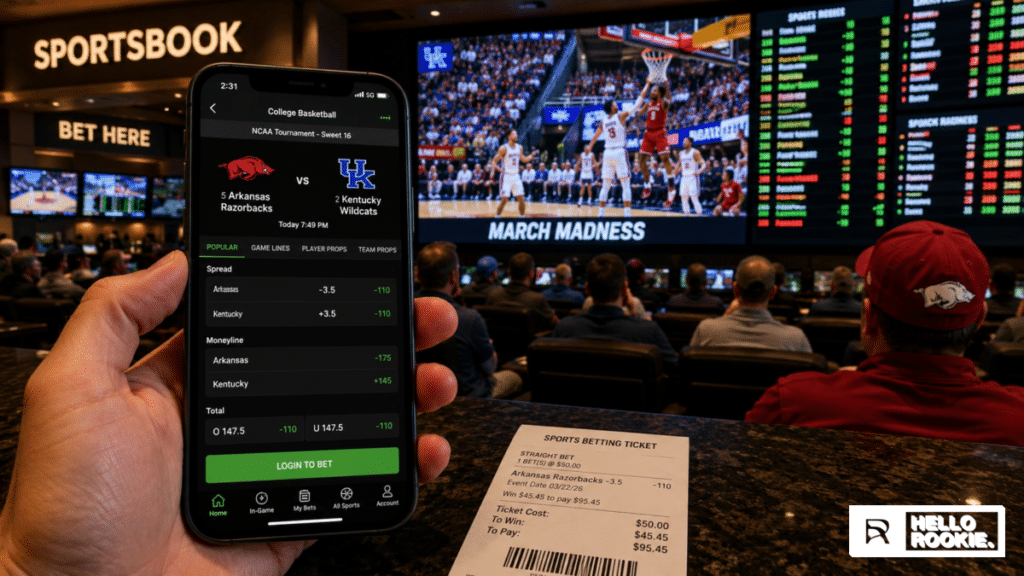
Both platforms went live on March 20, 2026, timed to coincide with the final stretch of NCAA March Madness — one of the busiest betting periods of the year. The Arkansas Razorbacks were still alive in the tournament, having advanced to the Sweet 16, which gave both companies an immediate local hook for promotional campaigns tied to the team.
What the Numbers Show
The March handle figures were released in late April and confirmed what the industry expected. The state’s three mobile operators combined for $86.6 million in wagers during March, up 40% from the same month the prior year. DraftKings and FanDuel together accounted for more than 60% of that total handle — despite being live for only the final 12 days of the reporting month. That concentration is extraordinary. Two operators that did not exist in the Arkansas market on March 19 accounted for the majority of the state’s total wagering volume by the end of March 20 through 31.
For context, Arkansas had handled $655 million in total sports bets across all of 2025 with three operators running for the full year. March 2026 alone, with the new entrants active for less than two weeks, already pushed the monthly record to $86.6 million. Oaklawn General Manager Wayne Smith had said before the launch that he expected handle to grow fivefold under the FanDuel arrangement. The early numbers suggest that trajectory is plausible.
The Local Operators and the Tax Question
The arrival of DraftKings and FanDuel did not go without objection. Saracen Casino, which operated BetSaracen and led the state’s market heading into 2026 with approximately $329 million in annual handle, had called for restrictions on out-of-state operators during the approval process. After the launch, Saracen Chief Marketing Officer Carlton Saffa questioned whether the national operators’ model would actually generate tax revenue for Arkansas, arguing that their structure tends to limit what states receive compared to locally-operated platforms.
That concern is not without basis. The 51% revenue retention rule was designed to keep the majority of sports betting profits inside Arkansas rather than flowing to corporate headquarters elsewhere. But the dramatic increase in total handle means the absolute amount of tax revenue should still rise even if the per-dollar rate flowing to local interests is subject to scrutiny. Arkansas taxes sports betting at 13% of net gaming revenue, and a much larger overall market generates more revenue at that rate regardless of how the underlying split is structured. Arkansas sports betting looks meaningfully different in 2026 than it did at the start of the year.
What It Means for the Industry
The Arkansas story is a clean example of what market access does for handle volume. States with restrictive frameworks that keep the major national operators out tend to generate lower per-capita wagering than states where DraftKings and FanDuel compete freely. The brand recognition, promotional budgets, and product depth that both companies bring translate into immediate user adoption even in markets where local operators have been established for years. For bettors in Arkansas, the practical effect is access to the same apps, odds, and features available in dozens of other states, delivered through familiar platforms rather than proprietary casino apps with more limited feature sets. The 40% year-over-year jump in March handle was driven by two weeks of activity — the full-year numbers will be worth watching closely.