
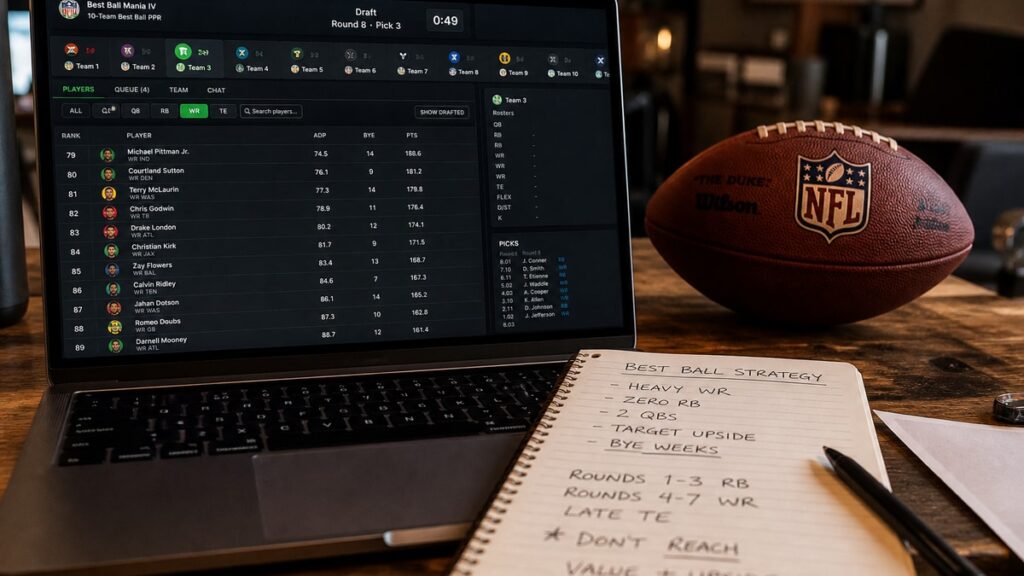
Best ball drafts are already underway across Underdog and DraftKings, and the single biggest strategic question of the summer is simple: how many running backs should you actually take early?
Quick take:
- Top name: Jahmyr Gibbs
- Why: Elite touch volume plus receiving work makes early-round running backs safer bets than in past cycles
- The number to watch: 16 running backs are now going in the first three rounds on Underdog, up from 15 last year
Zero-RB built its reputation on stories like Kenneth Gainwell going undrafted and finishing as a top-20 running back, or Rico Dowdle turning an RB54 price tag into RB22 production. Those hits are real, and they’re exactly why the strategy still gets discussed every summer. But the market has adjusted. Rather than blindly fading the position for the first four or five rounds, drafters heading into their leagues this year need to treat roster construction as a live decision made pick by pick, not a script written in April.
Why Running Backs Are Creeping Back Into Round One
The early Underdog ADP data tells a clear story: Jahmyr Gibbs and Bijan Robinson are going 1-1 and 1-2 in almost every mock and live draft, with Ja’Marr Chase as the top wide receiver in the 3.1-3.7 range depending on the site. Jonathan Taylor, Christian McCaffrey, James Cook, De’Von Achane and Ashton Jeanty are all being drafted inside the first two rounds as well. That’s a meaningfully more running-back-heavy top of the board than the “receivers only” boards that dominated best ball two or three years ago.
Part of the shift is structural. Running backs who catch a high volume of passes — Gibbs, Cook, Achane — offer weekly PPR floors that make them nearly as safe as receivers while still carrying standalone rushing upside receivers don’t have. That combination of floor and ceiling is why they’re going off the board ahead of pure rushers.
The Zero-RB Case Still Has Teeth
Zero-RB — waiting until at least round six to take your first running back — still has real backing this year, and Ja’Marr Chase, Puka Nacua, CeeDee Lamb and Amon-Ra St. Brown remain the receivers most cited as anchors for that build. The appeal hasn’t changed: load up on wide receivers and an elite tight end like Trey McBride or Brock Bowers in the first four rounds, then attack running back depth in bulk from round six onward, prioritizing pass-catching backs and high-profile handcuffs who have a real path to a starting role.
The strategy’s fatal flaw is also unchanged — Zero-RB only works if your cheap, late-round running backs actually hit. Going back several draft classes, backs taken in the final five rounds have rarely combined for even one usable fantasy week on average. If you’re building around this approach, you need at least one or two of your late fliers to smash, not just modestly outperform their price.
Running backs taken in the last five rounds of a best ball draft have historically produced almost no usable weeks — the hits have to be real hits.
That’s a tough needle to thread. It’s doable. It’s just not the free lunch it was when the market hadn’t yet adjusted to punish it.
Hero RB and Robust RB Offer a Middle Path
For managers uncomfortable going all-in on either extreme, Hero RB — taking exactly one running back in the first two rounds, then pivoting hard to receivers and pass-catchers before circling back to the position later — remains the most popular hybrid build heading into 2026. It lets you anchor your RB1 with a true bell cow like Bijan Robinson or Jonathan Taylor while still getting access to the receiver depth that best ball scoring rewards so heavily.
Robust RB, by contrast — taking two or more running backs in the first four rounds — is drawing more believers than it has in years given how many backs are now going early. With 22 running backs going between picks 25 and 120 this year (up from 19 last year), there’s a real argument that the position’s overall depth has thinned just enough to justify securing two workhorses up front rather than betting on volume finds in the double-digit rounds.
Quarterback and Tight End Timing Matters More in Best Ball
Best ball’s automatic lineup-optimization rewards spike weeks over floor, which is exactly why the “Elite QB” and “Elite TE” builds — spending an early pick to lock in a top-three passer or tight end — keep showing up in strategy breakdowns every summer. If you go that route with a quarterback, treat the pick as a real investment: you want that player starting for you nearly every week, not sitting as a hedge. Most rosters should finish with two to three quarterback slots filled, and if you take your QB1 early, don’t wait too long before adding a clear backup plan.
Stacking — pairing a quarterback with one of his own pass catchers — adds correlation that can produce the kind of massive single-week ceiling best ball formats are built to reward. Start looking for stacking opportunities the moment you roster your first player rather than trying to force one late. If you want to see how the market is pricing quarterbacks in season-long formats too, checking live NFL odds alongside your best ball board can help confirm which offenses are expected to throw the ball the most.
The Bottom Line
There’s no single correct build for every draft slot or every league. The right process is reading the board as it happens — noticing whether the drafters around you are hoarding receivers or backs — and adjusting rather than following a rigid script from a strategy article written months before your draft.
- Zero-RB and Hero RB remain viable, but the running back position is going earlier across the board in 2026 than it did a year ago.
- If you fade running backs early, your late-round hits need to actually hit — modest outperformance isn’t enough to save a Zero-RB build.
Whichever build you choose, the players you stash with picks beyond typical draft range — the sleepers nobody else values yet — are often what separates a good best ball team from a great one.