
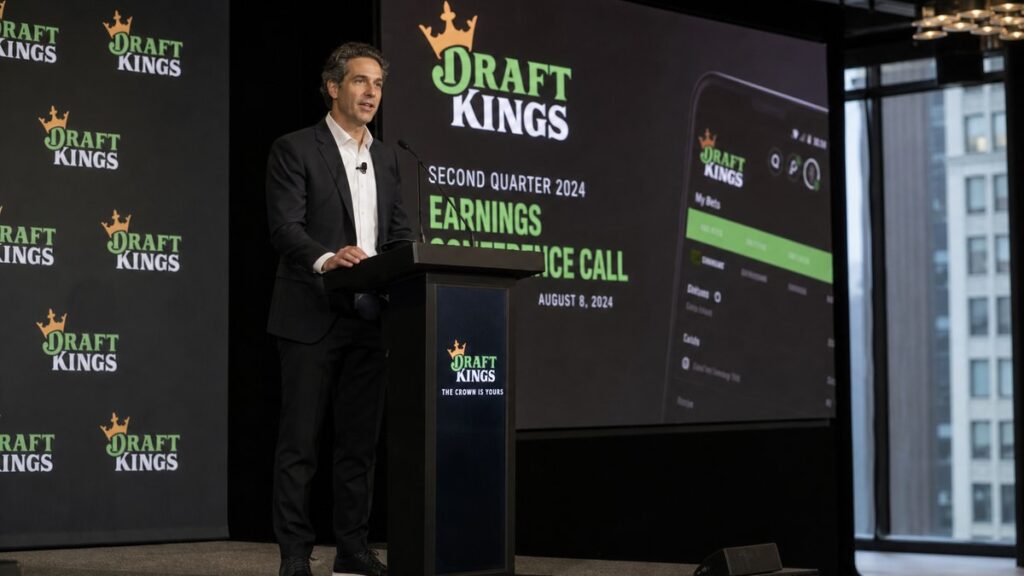
DraftKings spent most of Friday’s second-quarter earnings call fielding questions about prediction markets, and CEO Jason Robins made clear the company intends to grow its exchange business the same way it built its sportsbook a decade ago — carefully, and with data leading the way. With the NFL and college football seasons approaching, that message matters for anyone deciding where to put money down this fall.
“As the economics go, we’re looking at this in a way that is very similar to how we evolved in sportsbook,” Robins told analysts. “We started off, we had an LTV (lifetime value) model that we built in the early days of sportsbook. We were pretty cautious because we didn’t have a lot of data.” He added that DraftKings now has years of sportsbook data to lean on for customer acquisition assumptions, even though modeling the long-term value of prediction-market customers remains less certain. “I think we’ve been very careful and disciplined in how we’re doing that,” he said. “We’re not assuming major increases that we don’t have line of sight to.”
Predictions Growth Hasn’t Slowed the Caution
The discipline talk hasn’t come with a slowdown in growth. DraftKings’ predictions platform, which launched in late 2025, has already signed up more than 600,000 customers, and annualized trading volume jumped roughly five times over between April and July, hitting $11 billion in July alone. Consumer volume reached $3.6 billion annualized, while market-maker volume climbed to $7.4 billion annualized. Robins said DraftKings actually spent 10% more than planned on predictions customer acquisition after finding costs came in about 25% lower per customer than projected — a sign the company likes what it’s seeing even as it preaches restraint.
DraftKings plans to invest an incremental $200 million to $300 million in predictions during fiscal 2026 across marketing, product and technology. The company’s CFTC-regulated exchange, DK Exchange, is being phased in ahead of college football and the NFL, and Robins said the goal is to “port as much of that volume over to the exchange as fast as is reasonably possible.” He compared the buildout to how DraftKings once relied on outside vendors for its sportsbook before eventually bringing those pieces in-house, saying the company wants to own all three layers of the predictions stack — broker, exchange and market maker — the same way it controls its sportsbook technology today.
Little Overlap With Sportsbook Bettors, DraftKings Says
Robins also pushed back on the idea that prediction markets are simply cannibalizing sportsbook handle. He said DraftKings has found only about 1% crossover between users of its sportsbook and its prediction-market product in states where both are legal, and estimated 80% to 90% of prediction-market volume in those states comes from professional betting syndicates and institutional traders rather than typical recreational bettors. “We looked at a lot of internal data, also used some third-party data, and we have a number of different ways that we’ve triangulated various metrics to come to the same conclusion, which is there is very minimal, if any, cannibalization happening,” he said.
He also pointed to states without legal sports betting, including California and Texas, where DraftKings’ unified Super App now offers a sportsbook-like experience built around prediction contracts instead. More than half of predictions users have already placed combo bets — the prediction-market version of a parlay — which account for roughly 20% of total volume. Users can now access around 30 markets per game across the NBA, MLB and WNBA, a number Robins expects to expand significantly once football arrives. Bettors who want a head start before the season ramps up can compare the latest DraftKings promo code offers before signing up.
A Rough Quarter on Paper, But Guidance Holds
The discipline pitch came against a mixed quarter. DraftKings reported revenue of $1.44 billion, down from $1.51 billion a year earlier, missing Wall Street estimates after what the company said was an approximately $80 million hit from bettor-friendly game outcomes in June. The company posted a quarterly loss of $67.6 million, compared with a $157.9 million profit in the same period last year, and adjusted diluted earnings per share of $0.09 fell well short of the $0.22 analysts expected.
Despite the miss, DraftKings held its full-year guidance of $6.5 billion to $6.9 billion in revenue and $700 million to $900 million in adjusted EBITDA, with the core sportsbook business still expected to generate roughly $1 billion in adjusted EBITDA on its own — enough, executives said, to comfortably fund the predictions investment. DraftKings also closed the quarter with 3.6 million average monthly unique players, up 9.1% year over year, giving Robins a large existing base to point predictions traffic toward as football season nears.
Setting Up for a Football-Season Showdown
Robins framed DraftKings’ predictions strategy as a bet on patience over panic, wagering that the same playbook that made it a sportsbook leader will eventually work on the exchange side as competition with Kalshi and other prediction-market operators intensifies. With NFL and college football volume typically dwarfing other sports on both the betting and predictions sides, this fall will be the first real test of whether that disciplined buildout can hold up once millions of new customers start showing up at once. For bettors tracking where the two businesses might eventually blend together, keeping an eye on the NFL odds board this season will make the comparison easy to see in real time.