

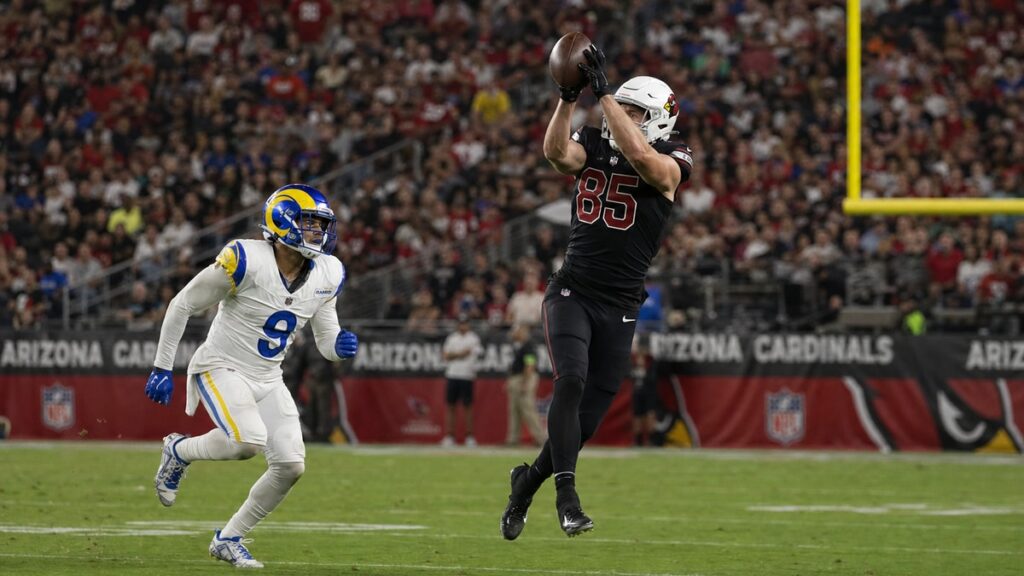
Tight end has quietly become the deepest, most fascinating position in fantasy football, and heading into 2026 there’s a real argument for a new breed of pass-catcher pushing the old guard toward the door.
Quick take:
- Top name: Trey McBride, Arizona Cardinals
- Why: He’s the total package — target hog, red zone weapon, and the focal point of Arizona’s passing game
- The number to watch: Colston Loveland’s 12.0 targets per game over his final four contests, including the playoffs
The position no longer starts and stops with the same handful of names it did five years ago. A wave of ascending, ultra-athletic tight ends has crashed into the veteran tier, and the gap between the top of the position and the murky TE2 range is as wide as it’s ever been. Draft the right guy early and you can win your league at the position. Miss, and you’re streaming all season.
The Clear-Cut 1-2 Punch
Trey McBride and Brock Bowers have separated from the pack, and it isn’t particularly close. McBride has become Arizona’s do-everything security blanket in the passing game, the kind of tight end who commands targets on early downs, third downs and in the red zone alike. Bowers, when healthy, offers a similarly dominant target share for the Raiders, pairing elite route-running with the kind of after-the-catch ability that turns a five-yard checkdown into a chunk gain. Both are being drafted inside the first three rounds across most formats, and both have earned that price tag with two straight seasons of legitimate WR1-caliber usage from the tight end spot. Anyone tracking how the position’s Super Bowl contenders shake out should keep an eye on both offenses all year.
Colston Loveland Is the Breakout Everyone’s Chasing
No tight end enters 2026 with more helium than Colston Loveland. The Bears rookie was a non-factor for most of his first six games, managing just 11 catches for 116 yards with zero touchdowns. Then something clicked. Over his final four games, including the playoffs, Loveland averaged 12.0 targets per game — a workload that has been matched by a tight end in NFL history only a dozen times, and just once by a rookie — while putting up 19.4 fantasy points per game over that stretch. He finished his rookie year with 58 catches for 713 yards and six touchdowns, leading Chicago’s entire receiving corps. With DJ Moore now in Buffalo and vacated targets sitting on the table in Ben Johnson’s offense, Loveland is being drafted as the clear TE3 in the back half of Round 4, and there’s a real path for him to finish as fantasy’s overall TE1.
The Rest of the Rookie-Fueled Tier
Loveland isn’t the only first-year tight end reshaping the position. Tyler Warren made the Pro Bowl in Indianapolis as a rookie, hauling in 76 passes for 817 yards and four scores, and analysts see a realistic path to 120-150 targets in Year 2 if the Colts’ offense stays healthy. Harold Fannin Jr. in Cleveland finished as fantasy’s TE6 as a rookie once David Njoku got hurt and the workload consolidated to him, posting 72 catches, 731 yards and six touchdowns. With Njoku now off the roster entirely, Fannin inherits the tight end room outright and should run a route on 85% or more of Cleveland’s dropbacks — the quarterback situation remains a real concern, but the target competition has thinned out considerably. Tucker Kraft in Green Bay rounds out this tier as a steady, ascending Tier 1/2 option in most consensus boards.
Three rookie-class tight ends from a single draft cycle now sit inside the top six at the position — a shift that has fundamentally changed how fantasy managers should approach the middle rounds.
Sam LaPorta and the Veteran Value Tier
Sam LaPorta remains one of the safer bets in the middle rounds. He’s part of Detroit’s “Core Four” alongside Amon-Ra St. Brown, Jameson Williams and Jahmyr Gibbs in a Lions offense that consistently ranks among the league’s most pass-friendly, and he was on pace for a third straight top-10 fantasy season before a back injury cut his 2025 short. George Kittle, somewhat remarkably, was actually the No. 1 tight end in PPR points per game last season at 15.8 — ahead of both Bowers and McBride — despite typically going off the board behind them. San Francisco locked him up with a new deal that runs through 2029, and he remains one of the highest-upside picks at the position even with a Round 3-caliber ADP.
Travis Kelce is back for a 14th season after re-signing with Kansas City on a one-year deal worth up to $15 million, turning down more lucrative offers elsewhere to stay with the only franchise he’s known. Kansas City’s staying power shows up clearly on the live NFL odds boards heading into the season. He still finished 2025 with a respectable 76 catches for 851 yards and five touchdowns and remained a top-10 tight end in snaps, routes and targets, but his 19.6% target share was his lowest mark since 2014. At 36, he’s best treated as a fringe TE1 rather than a locked-in weekly starter — the accumulated volume still shows up, but the ceiling has come down.
The Bottom Line
Draft McBride or Bowers early if the format allows it, and don’t be shy about reaching for Loveland ahead of his consensus price given the target competition he’s about to inherit. After that, the position turns into a genuine value hunt between rookie-fueled breakout candidates and steady veterans who still know how to find the end zone.
- Tier 1: Trey McBride, Brock Bowers
- Tier 2 (buy before the price catches up): Colston Loveland, Tyler Warren, Harold Fannin Jr., Tucker Kraft
Whichever tier a manager drafts from, the depth at tight end in 2026 means there’s no excuse for punting the position entirely.


