
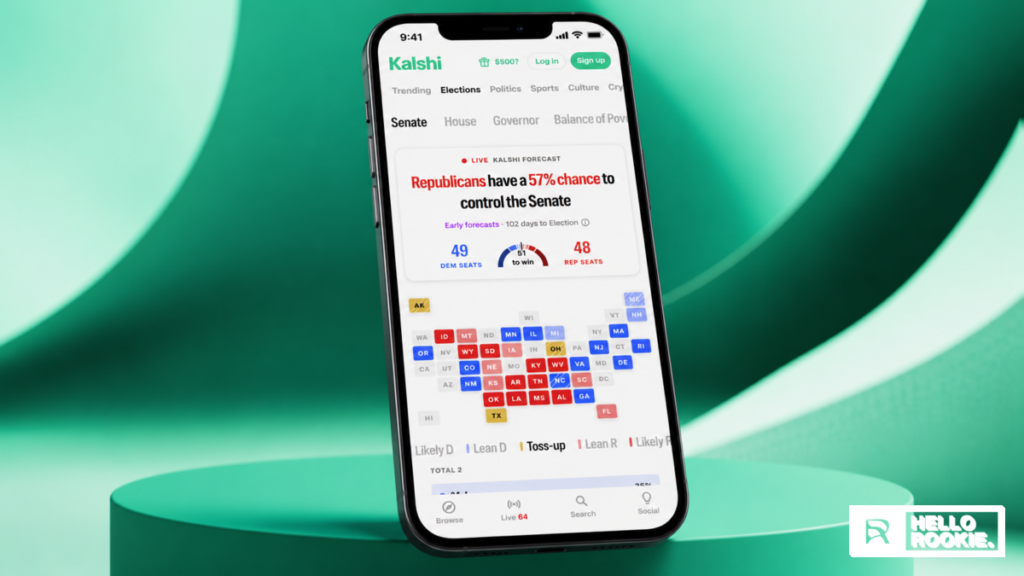
Kalshi has launched a new “Midterms Hub” that gives users a market-based view of the 2026 US midterm elections, drawing on live prices from its event contracts tied to Senate, House, and Governor races. For bettors who already treat futures markets and live odds as a second language, it’s a familiar format applied to a very different kind of contest.
The hub displays real-time odds for individual races across a map of the entire country, letting users see which contests are tight and which are all but decided, based on where traders are putting real money. Kalshi has drawn a sharp distinction between this and traditional polling: prices reflect what people are willing to risk on an outcome, not just what they say they believe when a pollster calls.
A Familiar Structure With Unfamiliar Stakes
For anyone who’s tracked Super Bowl futures or checked live lines before kickoff, the Midterms Hub will feel intuitive. Instead of win probabilities for a game, users get win probabilities for a Senate seat. Instead of injury news moving a line, a fundraising report or a debate performance can shift a contract’s price in real time.
Beyond the raw odds, the hub pairs market prices with polling averages sourced from VoteHub, plus Federal Election Commission fundraising data, historical results, and curated campaign news. Kalshi says the tool is built for voters, journalists, campaigns, and researchers as much as traders — and notably, about three-quarters of visitors to the platform reportedly don’t trade contracts at all, using it purely to check current odds the way a casual fan might check a scoreboard.
The CEO’s Pitch and the Skeptics’ Pushback
Kalshi CEO Tarek Mansour told CNBC that market-based pricing cuts through the noise in a way polling can’t. “They cut through polarization and show you what the wisdom of the crowds actually believes, backed by real money, not rhetoric,” Mansour said. Mansour, an MIT graduate who previously traded at Citadel and worked as an analyst at Goldman Sachs, has positioned prediction markets as a cleaner signal than survey-based polling.
Critics aren’t fully convinced. Some observers have raised concerns that prices on political contracts can be skewed by speculative trading, whale positions, or participants who claim to have inside information on a race — the same kinds of concerns that occasionally surface around thinly traded prop markets in sports betting.
Why This Matters for Sports Bettors
The bigger story here is the continued blurring of lines between sports betting and prediction markets. Kalshi and rivals like Polymarket have expanded well beyond politics and now offer contracts on game outcomes, player props, and season-long results — all regulated federally by the Commodity Futures Trading Commission rather than by state gaming regulators. That structure has let these platforms operate in states like California and Texas, where traditional sports betting apps remain illegal, and it’s fueled a wave of legal battles: Kalshi is currently facing more than two dozen lawsuits and enforcement actions from states arguing the company is running an unlicensed sportsbook under a different name.
Federal appeals courts have split on the question. The Third Circuit sided with Kalshi in April, ruling that its sports-related event contracts qualify as swaps under the Commodity Exchange Act and fall under CFTC jurisdiction rather than state gambling law. Courts in Massachusetts and Ohio have gone the other way, and Nevada has successfully blocked Kalshi’s sports contracts entirely following a Ninth Circuit ruling. The dispute remains unresolved on a national level, and more states are watching closely as trading volume on political and sports contracts continues to climb — more than $30 million has already been wagered on contracts tied to which party controls the House and Senate after November.
What to Watch Ahead of November
The Midterms Hub is Kalshi’s latest step in building out its political products, following the May launch of its “American Power Index,” a market designed to track which party is gaining or losing ground over time. Kalshi is marking the new hub’s release with an event in Washington, D.C., featuring political strategists and a live demonstration of the platform.
For bettors who split time between traditional sportsbooks and prediction markets, the midterms are shaping up as a real stress test — both for the platforms themselves and for the ongoing legal fight over whether these event contracts belong under sports betting regulation at all. Whichever way that fight resolves, the format on display in the Midterms Hub — live, tradable odds instead of static poll numbers — is clearly here to stay in some form.