
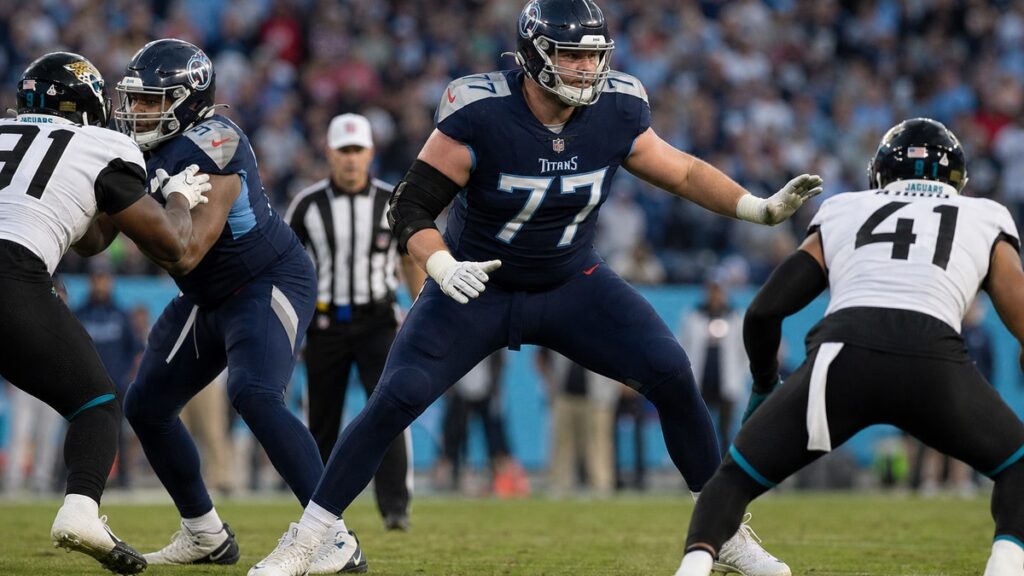
The Tennessee Titans locked up the anchor of their offensive line Friday, agreeing to terms with guard Peter Skoronski on a four-year extension worth $100 million, including $88 million guaranteed. NFL Network’s Ian Rapoport first reported the terms, which instantly make Skoronski the highest-paid guard in NFL history.
The move keeps Skoronski in Nashville through the 2031 season and comes just months after the Titans already exercised his fifth-year option for 2027. Rather than let that number become a bargaining chip down the road, general manager Mike Borgonzi opted to lock in the 11th overall pick from the 2023 draft well ahead of schedule, betting that the price only would have climbed had Skoronski hit the open market as one of the league’s premier interior blockers.
From Left Tackle Prospect to Franchise Cornerstone
Skoronski arrived from Northwestern as a decorated left tackle prospect, a unanimous All-American who started 33 consecutive games for the Wildcats without missing a snap. The Titans, however, saw his future inside at guard and made the positional switch immediately as a rookie. It has paid off in full. Skoronski started 14 games in 2023, then didn’t miss a single offensive snap across 17-game seasons in both 2024 and 2025 — a level of durability and consistency that’s rare at any offensive line spot, let alone one asked to relocate from tackle to guard at the pro level.
According to Pro Football Rumors, Skoronski and since-retired tackle Taylor Lewan are the only Titans first-round picks in the past 16 years to sign extensions with the franchise, underscoring how unusual it is for Tennessee to make this kind of long-term financial commitment to a player early. It’s a clear signal from the front office that, amid a build-up around young quarterback Cam Ward, the interior offensive line is viewed as non-negotiable infrastructure rather than a spot to keep churning through.
The financial framework of the deal is notable on its own. An $88 million guarantee is a positional record for a guard, and the $25 million average annual value tops the previous benchmark at the position by a wide margin. Skoronski was already ticketed for a projected $19.072 million in 2027 under the fifth-year option the Titans exercised earlier this offseason, but rather than let him play out that season and re-enter negotiations from a position of even greater leverage, Tennessee chose to get ahead of the market. Skoronski, for his part, called the extension a tremendous blessing when the deal was finalized. With 2024 first-round tackle JC Latham entrenched on the other side of the line, the Titans now have both of their recent top offensive line investments signed to multi-year deals, giving Ward a stable, homegrown foundation up front as he enters a pivotal second full season as the starter.
What This Means for Titans Betting Markets
The timing lines up with one of the more aggressive stretches of the 2026 offseason for skill-position and offensive-line spending, following extensions for Bijan Robinson, Jonathan Taylor and Jahmyr Gibbs that reset the running back market over the past week. Skoronski’s deal does the same at guard, and for bettors tracking Tennessee, it reinforces the read that the front office is building around Ward for the long haul rather than treating this season as a pure teardown.
That context matters for anyone eyeing Titans futures. Entering August, Tennessee sat at 6.5 wins on most win-total boards, with the Under carrying a slight price edge, and the Titans were priced around +13000 to win the Super Bowl and +800 to take the AFC South — long odds befitting a team coming off a 3-14 season. A locked-in interior line protecting Ward doesn’t move those numbers overnight, but it removes one layer of downside risk that oddsmakers typically bake into a rebuilding roster: uncertainty at the point of attack up front. Keeping Ward upright and the run game functional is foundational to any value case for the Titans clearing that 6.5-win number, and securing the guard spot for the next half-decade takes one variable off the table for a coaching staff still building continuity in Year One under Robert Saleh.
It also reads as a market signal for anyone shopping Ward’s long-term passing props and season-long passing yardage or touchdown totals — a quarterback’s ceiling is only as high as the protection in front of him, and Tennessee just spent nine figures making sure that protection doesn’t erode. Books rarely move numbers off contract news alone, but sharp bettors tracking roster continuity will note this as one more reason the Titans’ win total sits where it does rather than lower, and as a potential factor if Ward’s props see any preseason line adjustments once training camp reps confirm the group’s chemistry.