
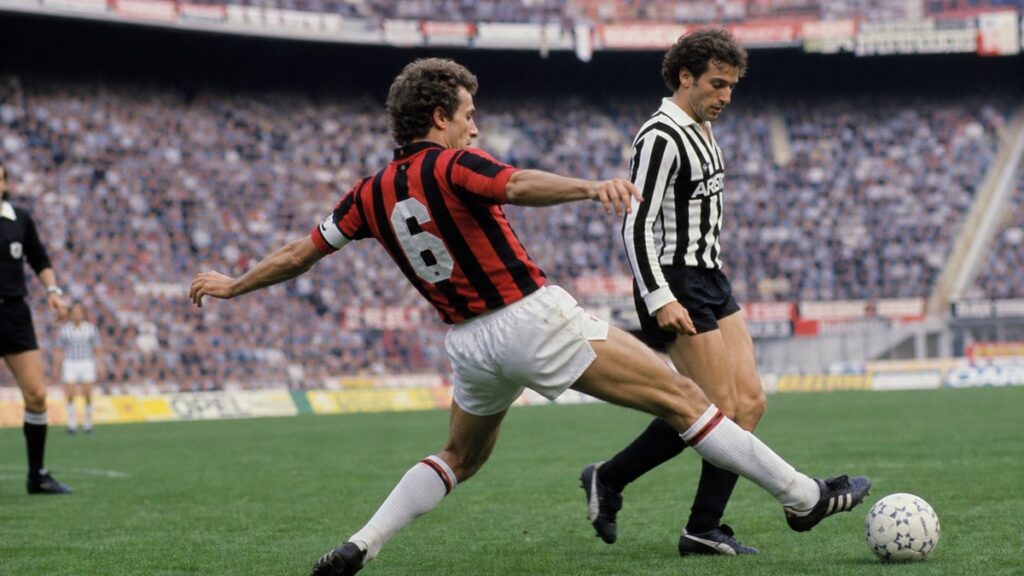
Franco Baresi, the AC Milan and Italy defender widely regarded as one of the greatest sweepers the sport has ever produced, has died at the age of 66, the club announced Friday. No cause of death was given, though Baresi had been dealing with health issues since undergoing surgery in August 2025 to remove a pulmonary nodule, after which he began a course of immunotherapy.
Baresi spent his entire professional career at AC Milan, debuting for the first team in April 1978 at just 17 years old and going on to make more than 700 appearances in the Rossoneri shirt over two uninterrupted decades. He was named captain at only 22, just months before helping Italy win the 1982 World Cup, and went on to lead Milan through the most dominant stretch in the club’s history — three European Cups and six Serie A titles among a trophy case that also included four Italian Super Cups, three European Super Cups and two Intercontinental Cups.
A Career Defined by Loyalty and Silverware
What set Baresi apart wasn’t just the medals — it was the loyalty. He stuck with Milan even after the club was relegated to Serie B twice in a three-season span, choosing to rebuild alongside a franchise that would soon become untouchable in Europe. That patience paid off almost immediately: Milan’s late-1980s and early-1990s sides, built around Baresi’s reading of the game from the back line, are still cited as one of the most feared teams ever assembled in European football, a level of dominance that would be nearly impossible to find in today’s Champions League odds market, where no side enters a season as heavily favored as those Milan teams once were. He finished runner-up to teammate Marco van Basten for the 1989 Ballon d’Or, a testament to how central his role was to that Milan machine even as attacking stars soaked up the individual headlines.
His international career carried its own share of triumph and heartbreak. Baresi earned 81 caps for Italy and featured in three World Cups, lifting the trophy in 1982 in Spain as part of the Azzurri squad. He missed the 1986 tournament in Mexico following a disagreement with the national team’s coaching staff, but returned to captain Italy to the 1994 World Cup final in the United States, where the Azzurri fell to Brazil on penalties — with Baresi among three Italian players to miss from the spot in one of the most gutting shootouts in tournament history.
Tributes Pour In From Across the Football World
AC Milan’s statement on Friday captured the weight of the loss inside the club: “The entire history of AC Milan is in tears. His example and integrity will remain forever embedded in the club’s DNA, just like his iconic number 6 shirt.” That number was retired when Baresi hung up his boots in 1997, a first for Italian football, and the club staged a celebration match in his honor featuring stars from across his career.
Journalist Fabrizio Romano relayed the news to a global audience, writing that Baresi had “passed away this morning at 66 years old” and calling him “an absolute legend of the game with AC Milan and Italy, marking an era for different generations.” Condolences followed from rivals and institutions alike, including Real Madrid, Juventus, Napoli and Italy’s Serie A, each acknowledging Baresi’s standing as one of the sport’s defining figures regardless of club allegiance. The tributes carried extra weight given that false rumors of his death had circulated just two days earlier, on July 29, and were officially denied by Milan before Friday’s confirmation made the loss real.
Baresi’s final public appearance came in February, when he carried the Olympic torch into the San Siro during the opening ceremony of the Milan Cortina Winter Olympics alongside former Inter Milan defender Giuseppe Bergomi — a fitting image of two rival legends sharing one stage in the stadium where Baresi built his legacy. He had been made honorary vice-president of Milan in 2020, a role that kept him close to the club long after his playing days ended. Fans who want to track how the current Rossoneri squad is faring against the standard Baresi and his teammates set can check live Premier League odds and other European markets as the new season approaches, with Milan’s modern-day ambitions still measured against that golden-era benchmark.
For a generation of supporters who never saw him play, Friday’s news is a reminder of how singular Baresi’s story was: a one-club man who helped turn a relegated side into a continental superpower, then spent decades afterward as a symbol of exactly what that club stood for. Football will now spend the coming days reflecting on a career that shaped not just AC Milan’s identity, but Italian football’s understanding of what a defender could be.