
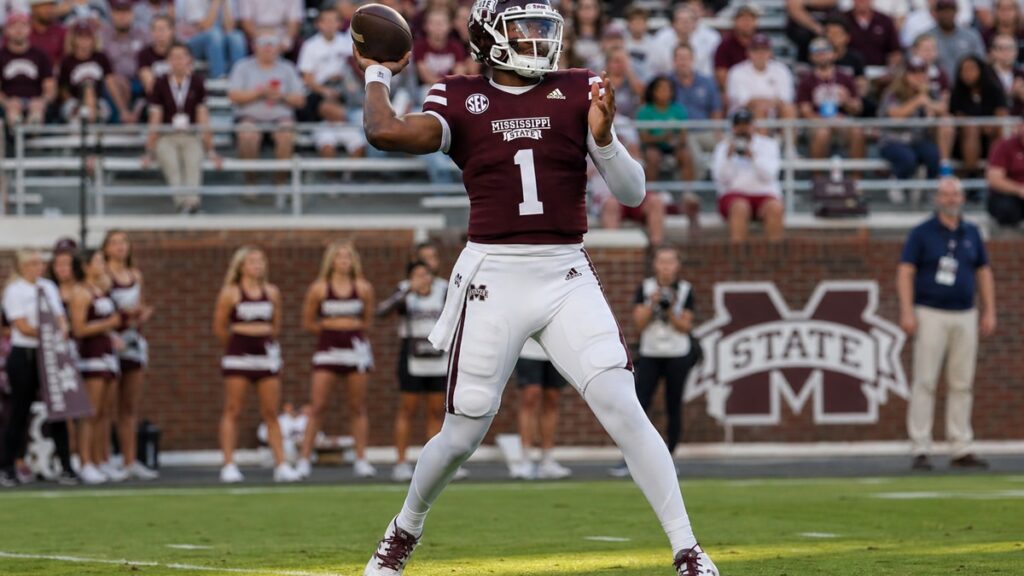
A New York Times/The Athletic report published Tuesday named Mississippi State quarterback Kamario Taylor as an early test case for how much the next transfer portal cycle could cost. According to the report, an SEC general manager indicated the Bulldogs could retain Taylor for a below-market deal if head coach Jeff Lebby remains in Starkville next season — but if Taylor tests the portal, he could command more than $4 million annually, in line with what the top transfer quarterbacks were paid last winter.
The gap between those two numbers is the story. Mississippi State is 2-0 to open the season, and Taylor, now a sophomore, has been the driving force behind it. His current market value sits nowhere close to $4 million by outside estimates, which is exactly why his situation has become a talking point for how fast quarterback compensation is inflating across the sport.
From Noxubee County to the Bulldogs’ most important player
Taylor arrived at Mississippi State as a four-star recruit in the 2025 class, ranked as the highest-rated quarterback signee in program history. The 247Sports Composite had him at No. 119 nationally and No. 11 at the position, and he was named Mississippi’s 3A Mr. Football as a senior at Noxubee County High School after throwing for nearly 2,900 yards and 40 touchdowns while adding over 1,200 rushing yards. Scouts flagged him as a high-ceiling, low-floor prospect — long, athletic and gifted with his legs, but still developing as a pure passer.
Two games into his sophomore season, that development is showing up on tape. Taylor opened the year completing 22 of 34 passes for 354 yards and four touchdowns in a 62-13 rout of Louisiana-Monroe, then followed it with a 16-of-22, 227-yard, three-touchdown showing to go with 86 rushing yards in a 38-13 win at Minnesota. The Bulldogs have outscored their first two opponents 100-26, and Taylor has been the headline reason why, prompting 247Sports to tab him the single most important player on the roster this season.
Lebby’s hot seat adds urgency to the retention math
The timing of Taylor’s breakout matters because of who is coaching him. Lebby enters his third season at Mississippi State on one of the hottest seats in the SEC, having gone 7-18 overall and 1-15 in conference play across his first two years, including a 5-8 finish and a bowl loss last season. Multiple outlets — USA Today, ESPN, CBS Sports and The Athletic among them — listed Lebby among the sport’s most vulnerable coaches entering 2026, even as the Bulldogs have opened 2-0.
That backdrop is central to the retention scenario described in the Athletic’s reporting: an SEC general manager framing Mississippi State’s ability to keep Taylor below market value as contingent on Lebby staying in place. A coaching change would almost certainly reset that calculus and push Taylor toward testing the market, where the report suggests he could match what last winter’s top transfer quarterbacks received.
What the $4 million number says about the transfer portal market
The scale of that projected number is what makes this a betting and market story as much as a football one. Independent tracking sites currently peg Taylor’s individual NIL valuation between roughly $1.2 million and $1.5 million — a fraction of the $4 million-plus figure now attached to his name if he enters the portal. A jump of that size would represent one of the more extreme public examples yet of how portal economics have detached from traditional player-valuation models, particularly at the quarterback position, where a small handful of proven, mobile, SEC-caliber passers can now command premiums once reserved for professional backups.
The number also fits into Mississippi State’s broader roster spending picture. The program’s football roster carries an estimated $22 million in total NIL value, with portal additions accounting for roughly 31% of that figure, or about $6.8 million, according to valuation trackers — a sign of how much of the Bulldogs’ current build already leans on the transfer market rather than high school recruiting or retention. If Mississippi State ultimately has to pay near market rate to keep its own starting quarterback, that only adds to the arms race pressure facing programs already stretching to fund rosters through the portal, and it raises the stakes on Lebby’s season-long performance as the single biggest variable in whether the Bulldogs pay a premium or a discount to keep their most important player in Starkville beyond this year.