
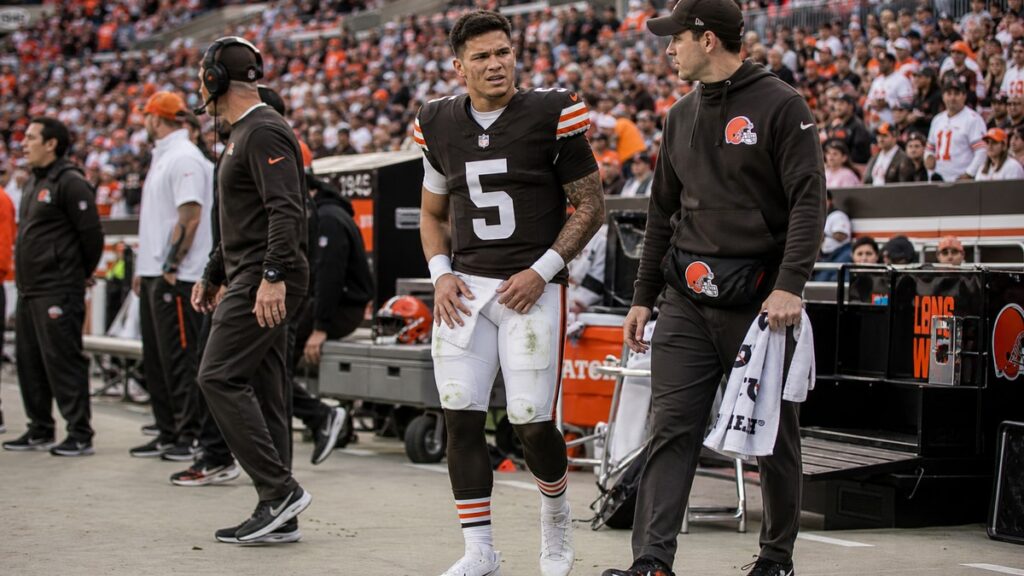
The Cleveland Browns placed third-string quarterback Dillon Gabriel on injured reserve with a back injury this week, a move that will keep him sidelined for at least the first four games of the season while carrying a designation to return as early as Oct. 11 against the Jets. The injury surfaced days after Gabriel’s standout performance in the preseason finale against New England, when he completed 12 of 15 passes for 186 yards and three touchdowns before the issue emerged.
Gabriel, a 2025 draft pick who has spent his brief career shuffling through Cleveland’s crowded quarterback room, appeared to be building real momentum toward locking down the No. 3 job before the back injury flared up during practice just days after his sharp outing versus the Patriots. Because he does not count against the 53-man roster while on injured reserve, the Browns effectively bought themselves a month before having to make a harder decision about his long-term role in the organization.
How the Injury Reshapes Cleveland’s QB Room
With Gabriel out, sixth-round rookie Taylen Green out of Arkansas becomes the Browns’ active No. 3 quarterback behind starter Deshaun Watson and backup Shedeur Sanders. Watson was named the Week 1 starter over Sanders in late August after a competition that stretched through camp and the preseason, while Gabriel had shown flashes in the exhibition schedule that made him a legitimate candidate to leapfrog Green on the depth chart before the injury intervened.
Cleveland’s roster math forced a decision by the 53-man deadline: the team had four quarterbacks in the building and space for only three on the active roster. Placing Gabriel on injured reserve with a designation to return solved that problem without requiring the Browns to commit to a final answer on his future. He remains under contract, can return as soon as Week 5, and gives the coaching staff a full month to evaluate whether Green is ready to handle QB3 reps if called upon, all while Gabriel rehabs his back on the side.
There’s also a reporting wrinkle worth watching. Team sources have described the injury as legitimate and not viewed internally as long-term, and there is no indication the timing was manufactured. But the outcome is undeniably convenient for a franchise that needed a clean way to keep a talented young passer in the fold without forcing a roster cut, a trade, or an awkward fourth-quarterback logjam. Gabriel gets four weeks to heal; Green gets four weeks of developmental reps as the emergency option; and the Browns get four weeks before they have to make any permanent call on Gabriel’s path in Cleveland.
What the Market Is Saying About Cleveland’s QB Situation
Betting markets had already treated the Watson-versus-Sanders competition as resolved well before Gabriel’s injury. Implied probabilities on Watson’s Week 1 starting job climbed into the mid-90s percent range in prediction markets in the days after the announcement, while Sanders and Gabriel both fell into low single digits. Gabriel’s move to injured reserve does little to change that hierarchy in the short term, since he was never in the mix to start Week 1 anyway, but it does affect longer-view roster and futures conversations around Cleveland’s quarterback depth.
With Gabriel unable to factor into any games for at least a month, any scenario involving a midseason quarterback change now runs almost exclusively through Sanders or, in a true emergency, the unproven Green. That matters for anyone watching Cleveland’s in-season quarterback-change markets, since the field of realistic replacement options just got thinner and more predictable for the next several weeks.
The bigger-picture market signal remains Cleveland’s season win total, which has hovered in the 5.5-to-6.5-win range depending on the book, with the under favored in most recent postings. That number was already built around uncertainty at the quarterback position given Watson’s shaky recent history and the unresolved questions behind him. Removing Gabriel as even a theoretical midseason option narrows the Browns’ contingency plans further if Watson struggles or gets hurt, reinforcing why the under has continued to draw support even after the starting job was settled. Cleveland also remains a longshot in the futures market for the AFC North, the AFC, and the Super Bowl, prices that were already baked in around Watson’s presumed Week 1 status and haven’t moved meaningfully on the Gabriel news.
For bettors tracking Cleveland’s win total or any in-season quarterback-change props, the practical effect of this move is straightforward: Sanders is now clearly the only proven backup option available to the Browns for at least the next month, which keeps his profile as the most relevant name in any quarterback-change market tied to Cleveland this season. Gabriel’s eventual return in October, and how the Browns choose to use him once healthy, remains a storyline worth revisiting once he’s eligible to rejoin the active roster.